

What First-Time Homebuyers Actually Pay at Closing in Los Angeles
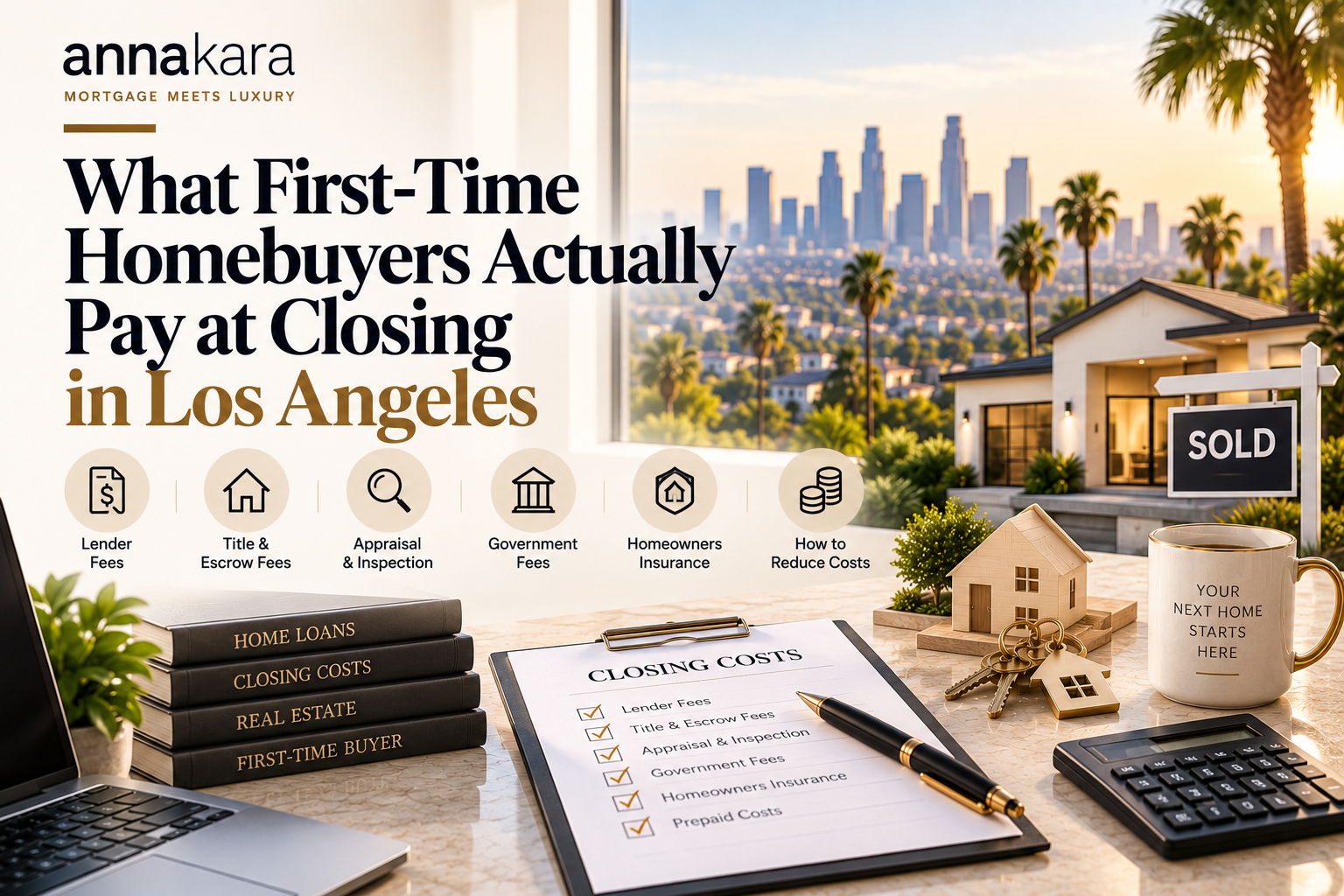
Closing costs are the fee category that surprises first-time buyers more than almost anything else in the transaction. Most people spend months focused on the down payment, then get a Closing Disclosure three days before signing and discover they owe an additional $18,000 to $30,000 on top of everything they already planned for. In Los Angeles, where purchase prices are high and the fee structure involves lenders, title companies, escrow officers, county recorders, and insurance providers all billing at the same time, understanding what you are actually paying before you get to closing is one of the most practical things you can do.
Before you are in contract on a specific property, use the mortgage calculator to build a rough payment estimate, then budget an additional 2% to 5% of the purchase price for closing costs. On a $900,000 home that means $18,000 to $45,000. The actual number depends on your loan type, your lender, whether the seller contributes anything, and which title and escrow providers you use. This guide walks through every category so you know exactly where that money goes.
What Closing Costs Are and Why They Exist
Closing costs are the collection of fees paid at the settlement of a real estate transaction. They cover three broad categories: fees the lender charges to originate and process your loan, fees paid to third parties who perform services required to close the deal (title search, escrow, appraisal, inspection), and government fees for recording the transfer of ownership and paying any applicable transfer tax.
These costs exist because buying a home involves multiple parties verifying the property, the title, and your financial ability to repay the loan before tens of thousands to hundreds of thousands of dollars change hands. The fees are not profit for any single party; they reflect actual services performed. Understanding that distinction helps you evaluate which fees are negotiable and which are fixed. If you are still orienting yourself on what programs and loan types are available to you, the first-time homebuyers overview covers that ground before you get into the cost detail below.
Lender Fees: What Your Bank or Broker Charges
Lender fees are disclosed in Section A of your Loan Estimate and are the one category where you have direct leverage when comparing lenders. On a conventional loan, expect to see an origination fee, which may be expressed as a flat dollar amount or as a percentage of the loan amount (commonly 0.5% to 1%), and potentially discount points if you are paying to buy down your interest rate. One discount point equals 1% of the loan amount and typically reduces your rate by 0.125% to 0.25% depending on market conditions.
Other lender fees include an underwriting fee (typically $500 to 1,500),aprocessingfee(300 to $800), and any application or rate lock fees. When you receive multiple Loan Estimates, compare Section A line by line across lenders. A lender quoting a lower rate but charging 1.5% in origination versus a lender charging 0.5% in origination may actually cost more in total depending on how long you keep the loan.
Third-Party Fees: Title, Escrow, and Appraisal
California is an escrow state, which means a neutral third-party escrow company coordinates the closing process, holds funds, and disburses them on the day the transaction records. Escrow fees in LA County typically run $2,000 to $4,000 depending on the purchase price, split between buyer and seller by convention (though this is negotiable in your purchase offer). The escrow officer manages the paperwork flow, receives your down payment and loan proceeds, pays off the seller's existing mortgage, and records the deed.
Title insurance protects against defects in the chain of ownership that were not discovered during the title search. In California, the seller typically pays for the owner's title policy (ALTA standard coverage) as a customary split, but the buyer pays for the lender's title policy, which protects the lender. The lender's title policy on an $800,000 loan runs roughly $1,000 to $1,800. The appraisal, which your lender orders to confirm the property value supports the loan amount, typically costs $650 to $1,200 in LA. You pay this fee upfront at the time of order, not at closing.
Government Fees: Recording, Transfer Tax, and HOA
The Los Angeles County Recorder charges a recording fee to document the transfer of title and the new deed of trust. This is typically $100 to $250 and is fixed by the county. The documentary transfer tax in LA County is $1.10 per $1,000 of purchase price, which on a $900,000 purchase equals $990. City of Los Angeles properties carry an additional city transfer tax. Buyers should also ask about any HOA transfer fees, resale document fees, or working capital contributions required when purchasing in a complex with a homeowners association, which can add $500 to $2,500.
Prepaid Items: The Category Buyers Most Often Confuse with Closing Costs
Prepaid items are not fees for services; they are amounts you pay upfront to fund accounts that will cover future obligations. For buyers using a loan, the lender typically requires an impound account for property taxes and homeowners insurance, and you must deposit a cushion into that account at closing. The impound setup typically requires two to three months of property taxes and two months of insurance premiums. On a jumbo loan where property values are higher, this impound cushion alone can run $8,000 to $15,000 and catches many buyers off guard because it looks like a closing cost but is actually your own money held in escrow.
You will also prepay interest from the day of closing through the end of the month. If you close on the 10th, you prepay 20 days of interest. On a $900,000 loan at 6.5%, that is approximately $3,200. Closing at the end of the month minimizes this prepaid interest charge, though it also means your first payment is due in roughly 30 days rather than 60.
Closing Costs by Purchase Price: Real Numbers for Los Angeles
The table below reflects realistic closing cost ranges for first-time buyers in Los Angeles County using a 30-year fixed conventional loan with no seller concessions. Numbers assume standard lender fees, average title and escrow rates, standard prepaid setup, and no discount points purchased.
| Purchase Price | Down Payment (5%) | Estimated Closing Costs | Prepaid Items (Approx) | Total Cash to Close |
|---|---|---|---|---|
| $650,000 | $32,500 | $13,000 to $18,000 | $6,000 to $9,000 | $51,500 to $59,500 |
| $800,000 | $40,000 | $16,000 to $22,000 | $7,500 to $11,000 | $63,500 to $73,000 |
| $950,000 | $47,500 | $19,000 to $26,000 | $8,500 to $13,000 | $75,000 to $86,500 |
| $1,100,000 | $55,000 | $22,000 to $30,000 | $10,000 to $15,000 | $87,000 to $100,000 |
These ranges assume 5% down. If you are putting down 3% (the minimum on most conventional first-time buyer programs), the loan amount is slightly higher, which increases lender fees, prepaid interest, and the impound cushion proportionally.
How First-Time Buyer Programs Affect Closing Costs
Several programs available to first-time buyers in California can reduce the out-of-pocket cash required at closing. The CalHFA MyHome Assistance Program provides a deferred-payment second mortgage of up to 3.5% of the purchase price that can be applied to either the down payment or closing costs. The CalHFA Zero Interest Program (ZIP) provides an additional amount specifically for closing costs. These programs have income limits and purchase price caps and require completion of a homebuyer education course. For self-employed borrowers who qualify for standard agency income documentation, these programs are available provided the base first mortgage also meets CalHFA guidelines.
Seller concessions are another significant lever for first-time buyers. In a transaction where the seller agrees to contribute toward your closing costs, you can reduce your out-of-pocket cash significantly. On a conventional loan, seller concessions are capped at 3% of the purchase price with less than 10% down and at 6% with 10% to 25% down. In LA's competitive market, whether sellers will agree to concessions depends on inventory and demand in the specific neighborhood at the time of your offer.
When Alternative Programs Make More Sense
Not every first-time buyer qualifies for standard agency loan programs, particularly those with non-traditional income, recent credit events, or properties that do not meet conventional guidelines. Non-QM loan programs allow lenders to underwrite based on bank statements, asset depletion, or other alternative documentation methods. Closing costs on non-QM loans are typically higher than on agency loans because these are portfolio products with higher lender origination costs. However, for a buyer who cannot document income conventionally, a non-QM loan with higher closing costs may be the only path to homeownership rather than a disadvantage.
The key with any program comparison is to look at total cost to close, not just the rate or the down payment requirement. A program that eliminates the down payment requirement but charges 2 points in origination fees may cost more at close than a conventional loan with a 5% down payment. Run the numbers for your specific loan amount before making assumptions about which path is cheapest.
How to Reduce Closing Costs Before Making an Offer
The most effective strategies for managing closing costs happen before you are in contract. Get Loan Estimates from at least two to three lenders and compare Section A fees directly. Choose a closing date near the end of the month to minimize prepaid interest. Ask your agent about properties where seller concessions are likely based on days on market and list-to-close history. Confirm whether the title and escrow companies your lender suggests are competitively priced or whether you can shop for alternatives under the TRID disclosure rules.
One cost that is fixed and non-negotiable is the appraisal. Do not let a buyer's agent or seller suggest waiving the appraisal to strengthen your offer on a first purchase unless you are prepared to close the gap between appraised value and purchase price entirely out of pocket. First-time buyers rarely have the reserves to absorb a $50,000 to $100,000 appraisal gap in the LA market, and a waiver that forces you into that situation eliminates any closing cost savings many times over.
Conclusion
Closing costs for first-time buyers in Los Angeles are significant and warrant the same level of planning as the down payment. On a typical LA purchase, total cash to close including down payment, closing costs, and prepaids runs 7% to 10% of the purchase price on a low-down-payment loan. Knowing the fee categories in advance, shopping lenders on Section A fees, and understanding what programs may offset some of those costs puts you in control of the transaction rather than surprised at the signing table.
If you want to walk through what closing costs would actually look like on a specific property and loan scenario you are considering, book a free consultation and I will build the full estimate with you before you make any commitments.
Frequently Asked Questions
-
Closing costs for first-time buyers in Los Angeles typically run 2% to 3% of the purchase price for the core fees, plus an additional 1% to 2% for prepaid items like the impound account cushion and prepaid interest. On a $900,000 purchase, total cash needed at closing (excluding the down payment) is commonly $25,000 to $40,000. The exact amount depends on the loan type, lender fees, closing date, and whether you receive any seller concessions.
-
On most purchase loans, you cannot roll closing costs into the loan amount the way you can on a refinance. The loan amount is determined by the lesser of the purchase price or appraised value, not by the purchase price plus costs. However, you can negotiate seller concessions where the seller pays a portion of your closing costs, effectively reducing the cash you need out of pocket without changing the loan amount. Some down payment assistance programs also provide funds that can be applied to closing costs.
-
Both parties pay closing costs, but the specific fees are divided by convention and negotiation. In Los Angeles County, the seller customarily pays the owner's title policy premium and a portion of the escrow fee. The buyer customarily pays the lender's title policy, their share of the escrow fee, the appraisal, lender origination fees, and all prepaid items. The transfer tax is typically split or negotiated in the offer. These conventions are not laws; they are defaults that can be changed in the purchase contract.
-
Closing costs are fees paid for services performed: lender origination, title insurance, escrow services, appraisal, recording. Prepaid items are funds you deposit into accounts that will cover future obligations: property tax impounds, homeowners insurance impounds, and per-diem interest from closing to end of the month. Both appear on your Closing Disclosure and both require cash at closing, but they serve different purposes. Prepaids are not gone; they sit in your impound account and are used to pay your bills when they come due.
-
No, but lenders will review your bank statements to confirm you have sufficient assets to cover the down payment and closing costs at the time of loan approval, not just at closing. The funds must be in your account for at least 60 days to be considered sourced. Large deposits that appear within the statement period require a letter of explanation and documentation of the source. Working with a lender early lets you understand the documentation requirements for your specific asset picture before you are in contract under time pressure.