

Renting vs Buying in Los Angeles: When Your First Mortgage Payment Can Beat Your Rent
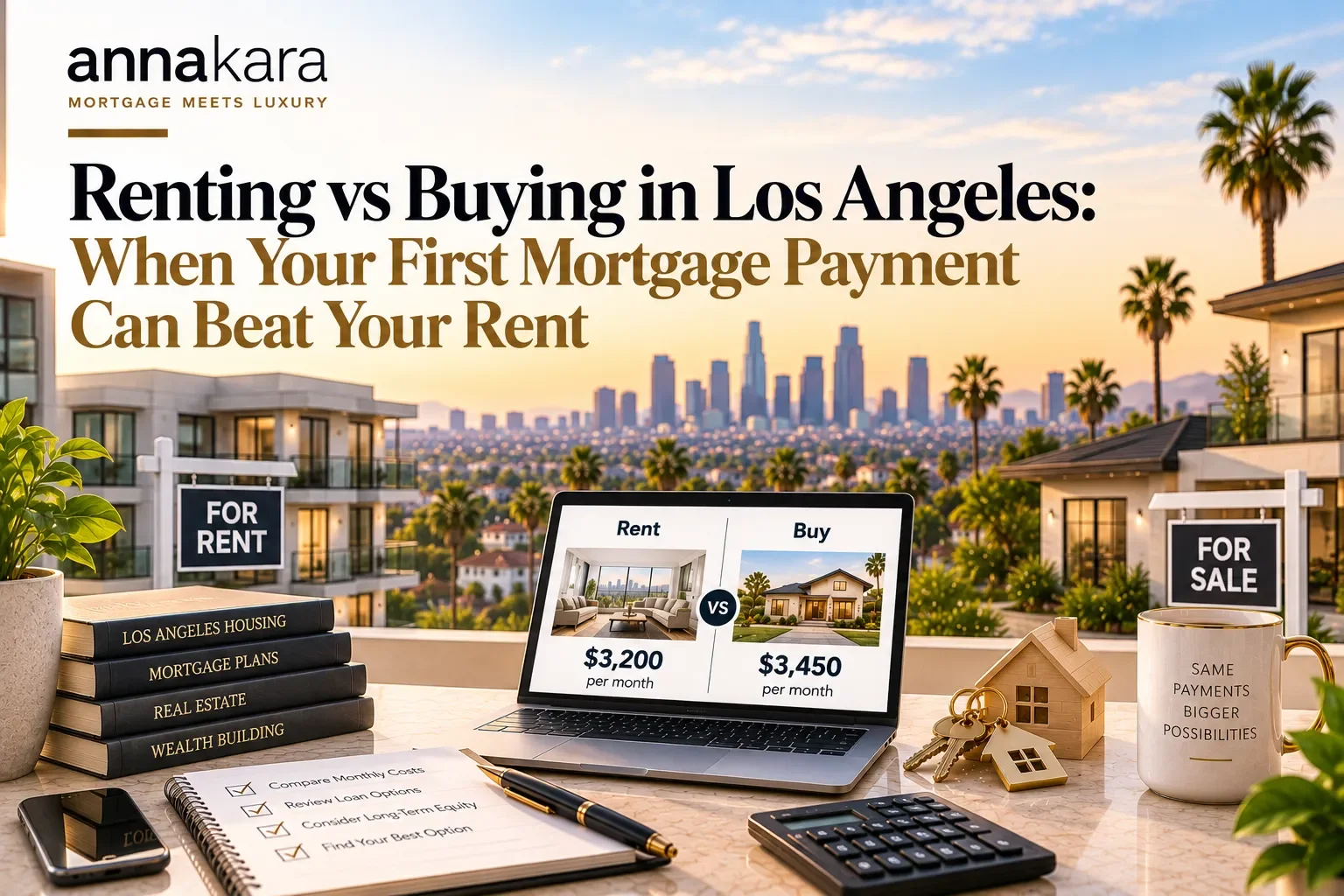
The assumption that buying a home in Los Angeles is categorically more expensive than renting is wrong in more situations than people expect. I have clients who discover, once they actually run the numbers, that a mortgage payment on a home they could realistically buy is within a few hundred dollars of what they are already paying in rent. Sometimes it is lower. The math does not always work out that way, and there are real situations where renting is the smarter short-term choice. But making that decision based on a feeling rather than a calculation often means staying out of the market years longer than necessary.
The place to start is a real number, not a guess. Use the mortgage calculator to input a realistic purchase price, your expected down payment, and a current interest rate estimate. The monthly output gives you something to compare directly against your rent. If you have not done that yet, the rest of this analysis will be more useful once you have a real figure to anchor to.
Why the Comparison Is More Competitive Than People Think
The rent vs buy comparison in LA is commonly framed as "buying is unaffordable," but that framing collapses several distinct questions into one. The question is not whether buying is expensive. It is whether the monthly cost of owning a specific property you can qualify for is materially worse than your current rent. For first-time homebuyers in LA's mid-market ($650,000 to $900,000 range), the gap between a mortgage payment and comparable rent has narrowed significantly over the past three years as rents have continued rising while some purchase prices in certain neighborhoods have moderated.
A one-bedroom apartment in neighborhoods like Silver Lake, Palms, or West Adams rents for $2,400 to $3,200 per month. A two-bedroom in those same areas runs $3,000 to $4,200. A buyer who qualifies for a $750,000 purchase with 5% down at a 6.75% rate carries a principal and interest payment of approximately $4,650 per month before taxes and insurance. Add property taxes (approximately $780 per month on a 750,000home),homeownersinsurance(100 to 150permonth),andPMIforasub-20%downpayment(200 to $350 per month), and the all-in housing cost is $5,730 to $5,930. That is meaningfully higher than renting a one-bedroom but competes directly with renting a two-bedroom in the same neighborhood. And it comes with a property you own.
The Price-to-Rent Ratio: What It Tells You
Economists use the price-to-rent ratio (purchase price divided by annual rent) to measure the relative value of buying versus renting in a given market. A ratio below 15 generally favors buying. A ratio above 20 generally favors renting from a pure financial return standpoint. Los Angeles as a whole has historically sat in the 25 to 35 range, which is one reason the "renting is smarter" argument circulates so persistently here.
But price-to-rent ratios are averages across a diverse market. In some LA neighborhoods and property types, the ratio is considerably lower. Condos in Mid-City or Koreatown, two-bedroom units in the San Fernando Valley, and townhomes in less-competitive submarkets often show ratios closer to 20 to 22. At those levels, the rent vs buy math is much tighter than the city-wide average suggests. The calculation also ignores mortgage principal paydown, appreciation, and tax benefits, all of which improve the ownership side of the ledger over time.
What Loan Type Changes the Monthly Payment Comparison
The loan program you use significantly affects the monthly payment. A conventional loan with 5% down carries PMI until you reach 20% equity, which on a $750,000 purchase means approximately 7 to 9 years of PMI at current amortization rates before it cancels automatically. A buyer who puts 10% down eliminates PMI sooner and reduces the monthly payment by $200 to $350. A buyer who puts 20% down eliminates PMI entirely and drops the payment by another meaningful amount. The entry cost goes up but the monthly cost comes down, which changes the rent vs buy comparison at every price point.
FHA loans with 3.5% down carry mortgage insurance premium for the life of the loan when the down payment is under 10%, which makes them more expensive monthly than a conventional loan at equivalent rates. On an FHA loan at $750,000 purchase price with 3.5% down, the MIP adds approximately $480 per month to the housing cost indefinitely. That math typically makes a 5% down conventional loan the better baseline comparison for buyers who can qualify for either.
Where the Rent vs Buy Gap Closes Fastest in Los Angeles
Certain pockets of LA present a more competitive buying case than others. The San Fernando Valley (particularly North Hollywood, Van Nuys, Reseda, and Canoga Park) has a lower price-to-rent ratio than the Westside or the Eastside trendy neighborhoods. A two-bedroom condo in North Hollywood can be purchased for $480,000 to $580,000 while renting for $2,400 to $2,900. That math begins to work for buyers with 5% to 10% down, particularly when they factor in the tax deduction for mortgage interest (applicable when itemizing exceeds the standard deduction) and property appreciation over a five-plus year hold.
Northeast LA neighborhoods (Eagle Rock, El Sereno, Lincoln Heights) and parts of South LA (Inglewood, Hawthorne) similarly show tighter price-to-rent dynamics. Buyers who are flexible about the exact submarket often find that a 20 to 30 minute drive from their ideal neighborhood shifts the rent vs buy math from "not yet" to "now makes sense."
The True Cost of Renting: What the Payment Does Not Show
Monthly rent payments build no equity. Every dollar paid in rent is an operating expense. Homeownership involves the same operating expense component (interest, taxes, insurance) but also includes a principal paydown component that builds ownership. On a $750,000 loan at 6.75%, year-one principal paydown is approximately $7,500. By year five, cumulative principal paydown is approximately $42,000. That amount accumulates entirely outside the renter's balance sheet.
Appreciation compounds the equity story further. Los Angeles real estate has appreciated at an average annual rate of approximately 5% to 7% over the past 30 years, though individual property outcomes vary significantly. A buyer who purchases at $750,000 and holds for seven years at 5% annual appreciation owns a property worth approximately $1,056,000. After subtracting the remaining loan balance and selling costs, the retained equity is substantial. A renter paying $3,500 per month over the same period has paid approximately $294,000 in rent with nothing retained.
When Buying at a Higher Price Makes More Sense
Buyers who have the income to support a larger loan but are hesitant because of the monthly payment should look carefully at the specific numbers before ruling out ownership. At the jumbo loan level (above $1,249,125 in LA County for 2026), the monthly payment obviously rises, but so does the rent for a comparable property. A single-family home in Los Feliz, Culver City, or Mar Vista that rents for $5,500 to $7,500 per month may be purchasable for $1.1 million to $1.4 million. At the upper end of that range, the mortgage payment may exceed rent. At the lower end, particularly for buyers with 20% down who eliminate PMI, the comparison becomes genuinely competitive.
What Self-Employed Renters Get Wrong About Their Options
A significant share of long-term LA renters are self-employed and have either been told they cannot qualify for a mortgage or have assumed that their tax return income is too low to support a loan. Both assumptions are worth testing. Self-employed borrowers who use conventional loan programs must document income using two years of personal and business tax returns, which can create a gap between reported income and actual cash flow. However, that is not the only path to qualification. Bank statement programs and asset depletion programs exist specifically for borrowers whose financial picture does not fit the W-2 mold.
For self-employed borrowers whose tax returns understate their real income, non-QM loan programs allow qualification based on 12 or 24 months of bank deposits rather than tax return AGI. These products carry slightly higher rates than conventional loans but open homeownership to a population of LA renters who have been incorrectly told buying is not available to them. If you are self-employed and have been renting because you believed a mortgage was out of reach, the qualification question is worth revisiting with current program options rather than with the assumption that was made years ago.
The Break-Even Analysis: How Long Until Buying Pays Off
The break-even point is the length of time you need to own the property for the total cost of ownership to equal (and then beat) the total cost of renting over the same period. It incorporates closing costs, the opportunity cost of your down payment, the principal paydown that accumulates in ownership, and the appreciation differential between the property and the investment you could have made with your down payment instead.
In Los Angeles, break-even timelines typically fall between four and seven years depending on the neighborhood, the purchase price relative to the rent alternative, and how aggressively the property appreciates. A buyer planning to stay in the property five to seven years or longer is generally in a position where buying competes favorably with renting once the full analysis is applied. A buyer who anticipates moving in two to three years should run the numbers carefully, because closing costs alone (roughly 3% to 5% of the purchase price) require meaningful appreciation just to recover.
Side-by-Side Comparison: Renting vs Buying in LA in 2026
| Factor | Renting ($3,200/mo) | Buying ($750K, 5% down) |
|---|---|---|
| Monthly housing cost | $3,200 | $5,750 to $5,950 (all-in) |
| Annual cost (year 1) | $38,400 | $69,000 to $71,400 |
| Principal paydown (year 1) | $0 | Approx $7,500 |
| Equity from appreciation (5% yr) | $0 | Approx $37,500 |
| Tax deduction benefit (est.) | $0 | $3,000 to $6,000 (varies) |
| Net annual cost after equity | $38,400 | Approx $24,000 to $30,000 |
| 5-year cumulative rent paid | $192,000 | Not recoverable (interest/taxes/ins) |
| 5-year cumulative equity built | $0 | Approx $80,000 to $120,000+ |
| Flexibility | High (lease term) | Low (selling costs to exit) |
| Control over space | Low | High |
The comparison table illustrates why the rent vs buy decision requires more than comparing the monthly payment. The higher monthly cost of ownership in year one is partially offset by equity accumulation and, for some buyers, a tax benefit on mortgage interest. Over a five-plus year hold, the ownership path typically produces a stronger financial outcome for buyers who stay put.
Conclusion
The rent vs buy question in Los Angeles does not have a universal answer, but it has a calculable one for your specific situation. The barriers to buying are real: down payment, qualification requirements, and the upfront cash needed at closing are all higher than in most US markets. But the assumption that buying is always worse than renting financially is not supported by the numbers in many parts of LA, particularly for buyers planning a five-plus year hold in a mid-market neighborhood.
If you want to run the actual comparison for a specific property or price range you are looking at, book a free consultation and I will build the side-by-side with your real numbers so you can make the decision based on math rather than assumption.
Frequently Asked Questions
-
In 2026, renting is typically cheaper on a month-to-month basis in Los Angeles. The all-in monthly cost of owning a home (mortgage, taxes, insurance, PMI) usually exceeds comparable rent by $1,500 to $2,500 per month at the entry-level price point with a low down payment. However, renting builds no equity. When total cost over a five-plus year period is compared, including principal paydown and appreciation, buying often produces a better financial outcome for buyers who plan to stay in the property.
-
The income needed to buy a home in Los Angeles depends on the purchase price, loan type, and down payment. As a general guideline, a $750,000 home with 5% down and a 6.75% rate requires approximately $170,000 to $185,000 in gross annual income to keep the debt-to-income ratio within standard underwriting guidelines. For FHA loans with 3.5% down, lenders typically allow up to a 50% back-end DTI under certain conditions, which can reduce the income threshold. Every situation is different based on existing debts, credit score, and loan program.
-
The break-even point in Los Angeles typically falls between four and seven years, accounting for closing costs, the opportunity cost of the down payment, and expected appreciation. A buyer planning to stay for five or more years is generally in a position where buying competes well with renting. A buyer who anticipates relocating in two to three years should analyze the numbers carefully, because closing costs alone require meaningful appreciation just to break even on the investment.
-
Yes. Conventional loans allow 3% to 5% down for qualifying first-time buyers. FHA loans allow 3.5% down with a minimum 580 credit score. Some down payment assistance programs in California, including CalHFA MyHome and CalHFA ZIP, can cover part or all of the down payment and closing costs for buyers who meet income and purchase price limits. The trade-off on low-down-payment loans is private mortgage insurance (PMI) or FHA mortgage insurance premium, which adds to the monthly payment until sufficient equity is reached.
-
Yes, though the qualification process is more involved than for W-2 employees. Self-employed borrowers using conventional loan programs qualify based on two years of average net income from personal tax returns, which can understate actual cash flow for borrowers who maximize deductions. Bank statement loan programs allow qualification using 12 to 24 months of bank deposits instead of tax return income, which is often a better fit for self-employed borrowers whose reported AGI is significantly lower than their actual cash receipts. Rates on bank statement programs are slightly higher than conventional, but the programs open up homeownership to borrowers who have been told standard qualification is out of reach.