

The Step-by-Step Refinancing Process in Los Angeles: What Actually Happens
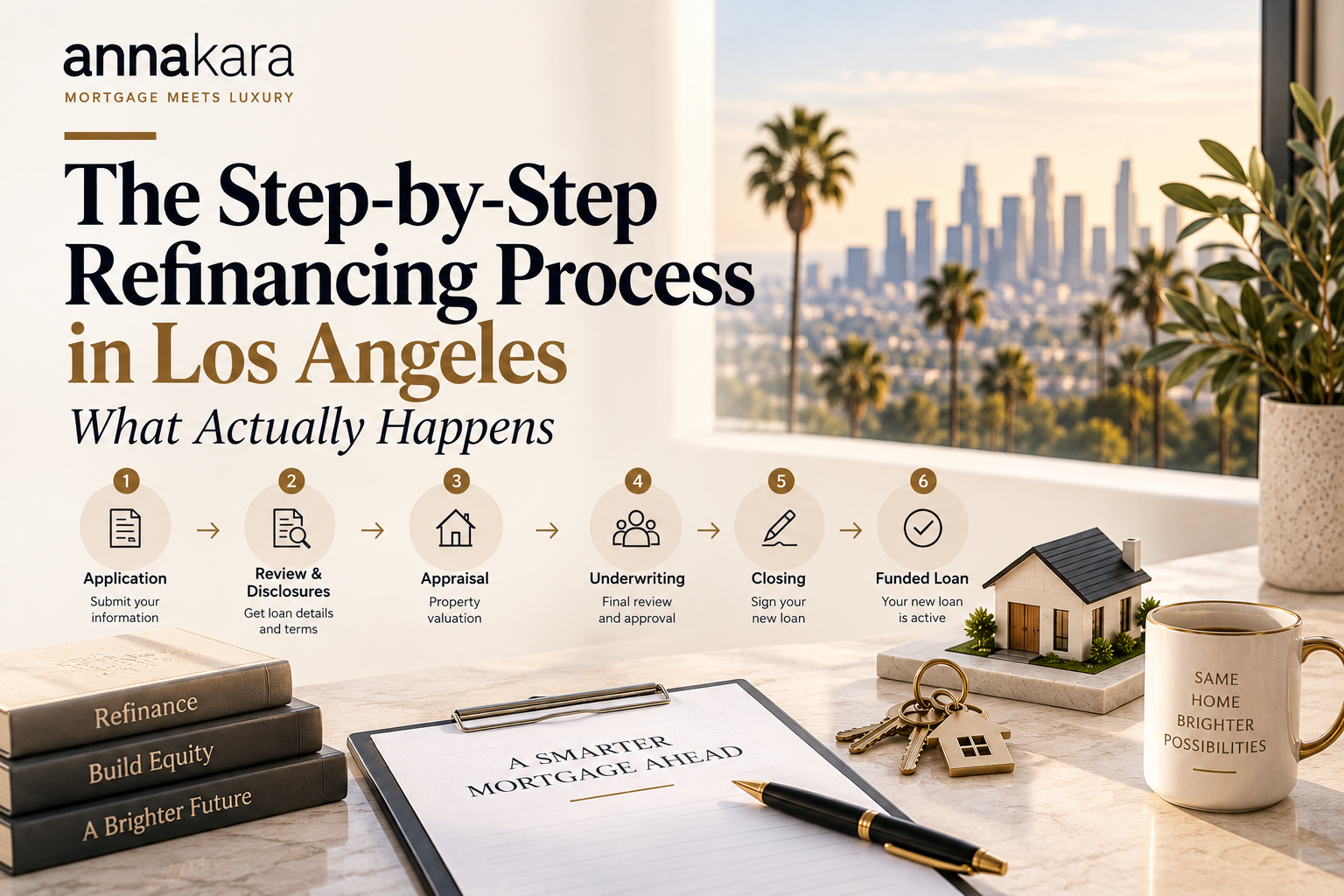
When borrowers ask me "how does refinancing even work?" I realize most of them are picturing something simpler than the reality. They expect to call a lender, get a new rate, sign something, and be done in a week or two. The actual process involves an application, disclosures, appraisal scheduling, underwriting, a new title search, and a closing with a three-day waiting period before the funds are released. None of that is complicated once you understand the sequence. But going in blind means surprises at every step.
Before the process begins, figure out whether refinancing makes financial sense for your situation. Use the mortgage calculator to estimate what your new payment would look like and how long it would take for your monthly savings to cover the cost of refinancing. Once that math makes sense, the steps below are what actually happen between your first call and your funded loan.
What Refinancing Actually Does
A refinance pays off your existing mortgage and replaces it with a new one. Your property does not change hands. The lender does not modify your existing loan. Instead, a completely new loan is originated, the proceeds are used to satisfy the old balance, and you begin making payments on the new loan under the new terms.
Your loan type can also change in a refinance. If you are currently in an adjustable-rate mortgage, a hard-money loan, or a non-QM program you qualified for with alternative documentation, a rate-and-term refinance is an opportunity to move into a fully amortizing fixed-rate loan if your income and equity now support it. The new loan is underwritten from scratch as if you had never borrowed before.
Step 1: Define What You Want the Refinance to Accomplish
There are three types of refinance transactions. A rate-and-term refinance lowers your interest rate, shortens your loan term, or both without changing your balance materially. A cash-out refinance increases your loan balance and delivers the difference to you as cash. A streamline refinance applies only to government-backed loans (FHA, VA, USDA) and simplifies the process by reducing documentation and appraisal requirements.
Your goal determines which loan type and program you are shopping for. Knowing that before you make your first call saves significant time because different goals lead to different questions, different underwriting requirements, and different rate quotes.
Step 2: Review Your Current Loan
Pull your most recent mortgage statement and identify your current principal balance, interest rate, and remaining term. Check whether your loan is a conventional loan, an FHA loan, or a VA loan, because that changes which programs you can refinance into and what documentation is required. Also check whether you have a prepayment penalty. Most standard loans originated after 2014 do not have prepayment penalties, but hard-money loans, some portfolio products, and older adjustable-rate mortgages sometimes do.
Also look at your current escrow balance. When your old loan is paid off at the close of the refinance, your escrow account balance is returned to you, typically within 20 to 30 days. That returned amount can help offset some of your closing costs or replenish the impound account on your new loan.
Step 3: Get Your Financial Documents in Order
For a standard refinance, lenders require two years of W-2s, the most recent 30 days of pay stubs, and two months of bank statements. If you are self-employed, expect to provide two years of personal and business tax returns, a year-to-date profit and loss statement, and potentially two years of business bank statements depending on the program. Getting these documents organized before you submit an application speeds up underwriting significantly and prevents the most common source of closing delays.
Pull your credit report before applying. If your score has improved since you bought, you may now qualify for a better rate tier. If there are errors on your report, dispute them before submitting your application, not after, because a lender cannot wait 30 to 60 days for a dispute to resolve once the clock is running.
Step 4: Shop Lenders and Get Loan Estimates
Contact at least two lenders and request a Loan Estimate for the exact same loan scenario: same loan amount, same rate type, same term. Loan Estimates use a standardized form under federal law (the TRID disclosure rules), which means you can compare Section A (lender origination fees) directly across lenders. This is the only fee column where you have real leverage.
On an LA loan of $800,000 to $1.2 million, a difference of 0.125% in origination fee equals $1,000 to $1,500. That is worth 30 minutes of comparison shopping. The rate matters, but so does the total cost in Section A, and many borrowers only look at the rate. Freddie Mac's guidance at freddiemac.com covers how to compare refinance offers in plain language if you want a reference before your first lender call.
Step 5: Submit the Application and Lock Your Rate
Once you choose a lender, you submit the full application. The lender pulls your credit (this is the hard inquiry that appears on your report), verifies the property address, and orders the appraisal. Within three business days, you receive the Loan Estimate. At this point you should lock your rate if you agree with the terms, because rates move daily and an unlocked quote is just that.
A 30-day rate lock is standard for a refinance. A 45-day lock is available at a slightly higher cost and makes sense if you are in a complex underwriting situation or if you expect an appraisal scheduling delay. In LA, appraisers can sometimes take 10 to 14 days to schedule, which has caused problems for borrowers with 30-day locks who did not account for it.
Step 6: The Appraisal
Most refinances require a full appraisal. The appraiser visits your property, photographs the interior and exterior, and compares your home to three to five recent comparable sales within a reasonable distance. For jumbo loan amounts above $806,500, some lenders require a second independent appraisal to confirm value on high-balance properties. In LA markets like Silver Lake, Echo Park, or Culver City, where sales can be highly variable, appraisal results are sometimes lower than sellers expect.
If the appraisal comes in lower than expected, you have options. You can dispute comparable selections with the appraiser if there are better recent sales that were overlooked, request a reconsideration of value through the lender, bring additional cash to closing to hit the required LTV, or in some cases switch to a program that allows a higher LTV.
Step 7: Underwriting
Once the appraisal is received and accepted, the file moves to underwriting. The underwriter reviews your income, assets, credit, and the property valuation to confirm the loan meets program guidelines. This phase takes 7 to 14 business days for a standard file. Complex income situations, such as multiple rental properties, recent job changes, or large deposits that need to be sourced, extend the timeline.
During underwriting you may receive a "conditional approval" with a list of conditions. These are typically additional documents the underwriter needs to satisfy program requirements. Respond to these quickly. Each day of delay on a condition is a day added to your closing timeline, and if your rate lock expires before closing, an extension costs money.
Step 8: Closing and the Three-Day Wait
Once all conditions are cleared, the lender issues a "clear to close" and schedules a signing appointment. At closing, a mobile notary or escrow officer meets you wherever is convenient and you sign the new loan documents. The signing takes 45 to 60 minutes.
After signing, federal law requires a three-business-day right of rescission on owner-occupied refinances. You can cancel within those three days without penalty. On the fourth business day, the lender funds the loan, the old mortgage is paid off, and the new loan is recorded. From that point forward, your first new payment is due on the first of the following month or the month after depending on when you closed.
What Makes an LA Refinance Different
Three factors make the LA refinance market distinct. First, loan balances. The median LA home value means most refinances involve balances of $700,000 to $1.4 million. Closing costs that are a percentage of the loan scale accordingly, and lenders apply tighter scrutiny to high-balance files because the dollar exposure per loan is large. Second, property types. LA has a significant inventory of condos, ADUs, non-warrantable buildings, and mixed-use properties that do not meet standard agency guidelines. If your property falls into one of these categories, your lender options narrow considerably. Third, escrow companies. California is an escrow state, meaning a licensed escrow company handles the closing coordination rather than a settlement attorney.
The Refinance Timeline From Start to Funded Loan
| Phase | Typical Timeline | What Happens |
|---|---|---|
| Application submitted | Day 1 | Hard pull, property info, rate lock discussion |
| Loan Estimate received | Day 3 | Federal deadline from application date |
| Appraisal ordered | Days 3 to 5 | Scheduled after application review |
| Appraisal completed | Days 10 to 18 | Varies by appraiser availability in LA |
| Underwriting review | Days 18 to 26 | Income, asset, credit, property review |
| Conditional approval | Days 22 to 28 | Document conditions to satisfy |
| Clear to close | Days 27 to 33 | All conditions met, scheduling begins |
| Signing | Days 30 to 35 | Notary or escrow closing |
| Rescission period | Days 31 to 37 | Three-business-day wait (owner-occupied) |
| Funding and recording | Days 33 to 40 | Old loan paid off, new loan recorded |
On a clean, well-documented file with no appraisal delays, closing in 30 to 35 days is realistic. Allow 40 to 45 days if your income is complex or if the appraisal takes longer to schedule.
Conclusion
Refinancing is not one thing that happens. It is a sequence of about a dozen distinct steps across 30 to 45 days, each of which has its own requirements and potential delay points. Understanding the sequence before you start means you can prepare documents in advance, manage your rate lock window correctly, and avoid the most common frustrations.
If you want to walk through what this process looks like specifically for your loan, property, and income situation before committing to anything, book a free consultation and I will map out the timeline and the likely cost of your specific transaction.
Frequently Asked Questions
-
Most California refinances take 30 to 45 days from application to funded loan. The three-business-day right of rescission is a federal requirement on owner-occupied refinances that adds to the timeline after signing. Streamline refinances on FHA or VA loans can close faster, sometimes in 20 to 25 days.
-
For W-2 employees: two years of W-2s, 30 days of pay stubs, two months of bank statements, a copy of your homeowner's insurance policy, and your most recent mortgage statement. For self-employed borrowers: two years of personal and business tax returns, year-to-date profit and loss statement, and often two years of business bank statements.
-
Only if you refinance into a new 30-year loan. You can refinance into a 20, 15, or even 10-year term to keep or shorten your payoff date. Shorter terms carry lower interest rates in most market environments, so there is often a rate benefit to choosing the term that matches your remaining timeline rather than defaulting to 30 years.
-
Most programs have a seasoning requirement. Conventional refinances typically require 6 months of payments on the existing loan before you can refinance. FHA streamlines require at least 6 months of timely payments. Cash-out refinances typically require 12 months of ownership. There is no law that prevents you from refinancing sooner, but program eligibility and closing cost logic often make a sub-6-month refinance impractical.
-
Your old escrow account is closed when the loan pays off. Your old lender is required to return the balance to you, typically within 20 to 30 days of payoff. Your new loan will establish a new escrow account with impound reserves based on your current tax and insurance balances. You will need to fund those reserves at closing, which is one of the costs that surprises first-time refinancers
