

7 Mistakes to Avoid With a Self-Employed Mortgage Loan in LA
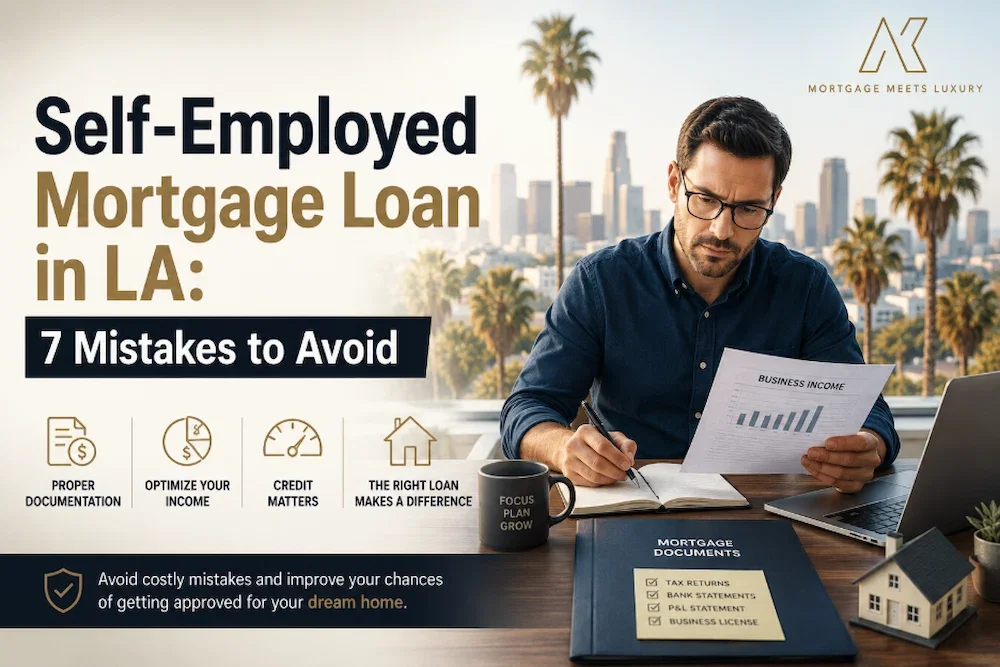
Running your own business in Los Angeles comes with real freedom, but applying for a mortgage? That part rarely feels free. Traditional lenders are built around W-2 income and pay stubs. If you are a freelancer, business owner, consultant, or independent contractor, qualifying for a self-employed mortgage loan in LA takes more preparation and a clear-eyed look at what lenders actually evaluate.
The encouraging truth is that most denials and delays are preventable. They trace back to a handful of common mistakes borrowers make before or during the application process. Fix these, and your path to approval gets significantly smoother.
Mistake 1: Writing Off Too Much Income Before You Apply
This is the most expensive mistake self-employed borrowers make. You have spent the year doing everything right, deducting business expenses, vehicle costs, home office use, equipment, and subscriptions. Your tax bill is low. But when a lender reviews your returns, they use your net income after deductions, not your gross revenue.
High write-offs shrink your qualifying income on paper, even when your actual cash flow is strong. Lenders cannot lend against money that does not appear on your tax return. This is one of the biggest concerns with tax write-offs and mortgage qualification: excessive deductions can quietly reduce your borrowing power.
What to do: Consult a mortgage specialist before tax season. Understanding which deductions affect your qualifying income, and which ones to hold off on, can meaningfully change how much home you can buy.
Mistake 2: Walking In Without the Right Documentation
Self-employed applicants carry a heavier documentation burden than salaried borrowers. Showing up unprepared or with inconsistent records is one of the fastest ways to stall the process.
For most self-employed applications in LA, lenders want to see:
• Two years of personal and business tax returns
• 12 to 24 months of bank statements (personal and/or business)
• A CPA-prepared profit and loss statement
• Proof of self-employment, such as a business license, CPA letter, or DBA registration
• Evidence of active, ongoing business operations
Inconsistencies between your bank statements and tax returns create underwriting flags, and missing documents cause delays. Get organized at least three to six months before you apply. Many avoidable income pitfalls stem from nothing more than incomplete or inconsistent paperwork.
Mistake 3: Applying for the Wrong Loan Program
Not every mortgage product works for self-employed income. Many borrowers apply for a conventional loan simply because it is familiar, only to face a denial that a better-fit program could have avoided.
If your reported net income after write-offs is lower than your actual earnings, a bank statement loan or non-QM loan may be a stronger route. These programs evaluate income based on real cash deposits rather than tax return figures. They exist precisely because the industry recognizes that high-earning self-employed borrowers often look less qualified on paper than they truly are.
A specialist in self-employed mortgage lending in LA can match you to the right program before you apply, not after a denial.
Mistake 4: Inconsistent Income Between Years
Lenders review two years of income for most programs, so a major swing between year one and year two raises questions. If you earned $130,000 one year and $65,000 the next, lenders will average the two, and some will use the lower year's figure if income is trending downward.
| Scenario | Year 1 Net Income | Year 2 Net Income | Qualifying Income Used |
|---|---|---|---|
| Stable | $90,000 | $92,000 | $91,000 (2-yr average) |
| Increasing | $75,000 | $95,000 | $85,000 (2-yr average) |
| Declining | $110,000 | $80,000 | $80,000 (lower year) |
| Bank statement program | N/A | Deposit-based | Based on 12 to 24 mo. of deposits |
If your business had a documented difficult year, be prepared to explain it in writing with supporting evidence. Underwriters can work with context; they cannot work with unexplained gaps.
Mistake 5: Ignoring Your Credit Score Until It's Too Late
Your credit score is one of the most controllable factors in any mortgage application. A score below 620 limits your program options considerably, while a score above 700 improves your rate and expands what is available to you.
Common credit issues for self-employed borrowers include:
• High credit card utilization from business expenses charged to personal cards
• Missed payments on accounts that report to personal credit
• Multiple hard inquiries from shopping lenders too close together
• Unresolved collections or aged derogatory marks
Pull your credit report at least six months before applying. That window gives you real time to pay down balances, dispute errors, and let positive changes show up before a lender pulls their own report.
Mistake 6: Mixing Personal and Business Finances
Lenders review bank statements to verify income. If business deposits flow through a personal account, or personal spending runs through your business account, underwriters will struggle to isolate a clean income figure, and that confusion never works in your favor.
Separate accounts create a clear, credible income story. Business revenue stays in the business account. Owner draws are transferred on a predictable, documented schedule. This level of organization reduces underwriter questions, speeds up your file, and signals financial discipline, all things lenders want to see from a self-employed borrower.
Mistake 7: Starting the Process Too Late
Los Angeles is a competitive market, and self-employed mortgage files take longer to process than standard W-2 applications. More documentation, more income analysis, and more underwriting review all add time. If you wait until you find the right home to start your mortgage, you may lose it to a buyer who was already pre-approved.
Plan to begin the process six to twelve months before you intend to purchase. Early pre-approval also uncovers documentation issues or income gaps with enough runway to fix them, well before they become deal-breakers at the worst possible moment. Getting ahead of it also helps you avoid the tax write-off challenges that can surface during underwriting.
Documentation: Self-Employed vs. W-2 Borrowers
| Document | W-2 Borrower | Self-Employed Borrower |
|---|---|---|
| Pay stubs | Required | Not applicable |
| W-2 forms | 2 years | Not applicable |
| Tax returns | Sometimes | 2 years (personal + business) |
| Bank statements | Sometimes | 12 to 24 months |
| Profit and loss statement | Not required | CPA-prepared, often required |
| Business license / CPA letter | Not required | Required |
| 1099 forms | Not applicable | Helpful, sometimes required |
What Lenders Are Really Evaluating
Behind every approval decision is a lender answering one question: can this person reliably repay the loan? For self-employed applicants, the answer has to come through documentation, not assumption.
Strong applications consistently show:
• Two years of stable or growing net income
• A credit score of 620 or higher (700 or above for the best rates)
• A debt-to-income ratio at or below 43 percent
• Clearly separated personal and business finances
• Organized, consistent documentation across every source
• A down payment of 10 to 20 percent, depending on the program
The cleaner your file, the fewer questions it generates. Fewer questions mean faster approvals.
Choosing the Right Mortgage Partner Matters
Self-employed lending is a specialty. Not every broker has hands-on experience with bank statement programs, non-QM income structures, or the specific nuances of income averaging for business owners in Los Angeles.
Working with someone who focuses on self-employed borrowers means your file is structured correctly from day one. The right specialist knows which lenders accept which documentation, how to present fluctuating income in its strongest light, and which programs fit your income profile.
If you want to explore your options with a team that has done this before, you can book a consultation to get clarity on where you stand before you formally apply.
Conclusion
Buying a home in Los Angeles as a self-employed borrower is completely achievable. It simply requires earlier preparation, stronger documentation, and guidance from someone who understands how this type of income works in a mortgage context.
The mistakes in this guide are not obscure edge cases. They are the exact issues that come up again and again for business owners, freelancers, and independent contractors. Avoid them, and you are already ahead of most applicants in the same position. Staying mindful of common income pitfalls and planning around tax write-off decisions can make the entire approval process much smoother.
Anna Kara Loans works with self-employed borrowers across Los Angeles every day, helping them navigate income documentation, choose the right loan program, and close with confidence. When you are ready to take the next step, the right team is here.
Frequently Asked Questions
-
Some programs, particularly bank statement loans and non-QM products, may accept one year of self-employment if you have prior experience in the same field and strong documentation. Most conventional programs still require two years. Your broker can identify which programs fit your specific timeline.
-
Multiple hard inquiries within a short window (typically 14 to 45 days) are usually counted as a single inquiry for mortgage purposes under most credit scoring models. Shopping lenders is reasonable; just do it within a compressed timeframe rather than spreading it across months.
-
A bank statement loan qualifies you based on 12 to 24 months of deposit history rather than tax returns. A standard self-employed mortgage uses tax return net income. Bank statement loans are especially useful when write-offs have reduced your reported income but your actual cash flow is strong.
-
Business debts that appear on your personal credit report are generally included in your DTI calculation. Debts held only in the business name, with no personal guarantee, may not be counted, depending on the lender and loan program. It is worth clarifying with your broker during pre-approval.
-
Not always. Requirements vary by program. Bank statement loans and non-QM products sometimes require 10 to 20 percent down. If you qualify through standard documentation with strong returns, conventional programs can go as low as 5 percent. Your loan structure will determine what is required.