

Jumbo Loan vs Conventional Mortgage: Which Fits Your LA Home Purchase?
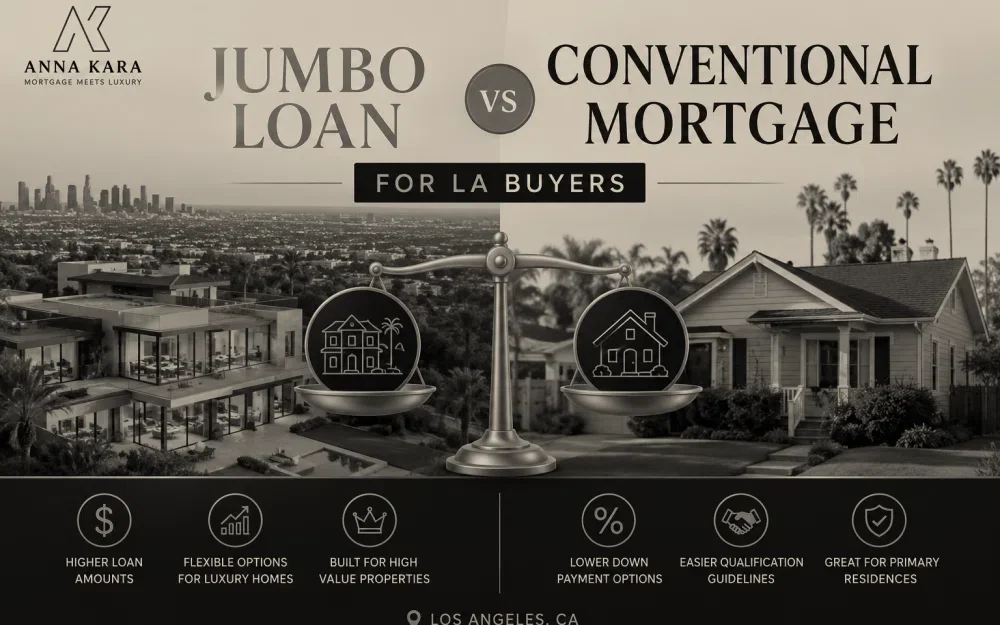
Buying a home in Los Angeles is never a small decision, and for most buyers, it is not a small loan either. With median home prices sitting well above the national average, LA buyers often find themselves at a crossroads: does their purchase call for a conventional mortgage, or do they need a jumbo mortgage loan?
The answer depends on the price of the property, your financial profile, and your long-term strategy. This guide breaks down both loan types clearly so you can walk into the process informed, confident, and ready to move.
What Is a Jumbo Mortgage Loan?
A jumbo mortgage loan is any home loan that exceeds the conforming loan limits set by the Federal Housing Finance Agency (FHFA). These limits define how large a loan can be and still be eligible for purchase by Fannie Mae or Freddie Mac. In high-cost areas like Los Angeles County, the conforming limit is significantly higher than the national baseline but many LA properties still exceed it.
Because jumbo loans fall outside the conforming guidelines, they are not backed by government-sponsored entities. Lenders take on more risk, which is why they typically apply stricter qualification standards. That said, for buyers targeting luxury homes, hillside estates, or any high-value property in LA's competitive market, a jumbo loan is often the only path forward.
Common features of a jumbo mortgage loan include:
Loan amounts typically starting above the area conforming limit (often $625,501 and above in LA)
Available in fixed-rate (10, 15, 20, 25, or 30-year terms) and adjustable-rate (ARM) options
No mortgage insurance (MI) required in most cases
Interest-only payment options available for qualifying borrowers
Loan amounts that can reach $2 million or more
What Is a Conventional Loan?
A conventional loan is a standard mortgage that conforms to the guidelines set by Fannie Mae and Freddie Mac. It is not government-insured like FHA or USDA loans. Conventional loans are the most widely used mortgage product in the US — and in many parts of LA where home prices fall within the conforming ceiling, they remain a solid and cost-effective choice.
To understand how conventional loans work in detail within the Los Angeles market, the Conventional Loan Requirements Explained for LA Homebuyers blog post is worth reading before you apply.
Key features of a conventional loan include:
Loan amounts at or below the FHFA conforming limit for your county
Down payment options as low as 3% for qualified first-time buyers
Private mortgage insurance (PMI) required if your down payment is below 20%
PMI can be removed once you reach 20% equity in the home
More lenders compete for conventional loans, often resulting in competitive rates
Jumbo vs Conventional Loan: Side-by-Side Comparison
This table gives you a clear look at how both loan types stack up across the most important categories for LA buyers.
| Feature | Jumbo Mortgage Loan | Conventional Loan |
|---|---|---|
| Loan Amount | Above conforming limit (typically $625,501+) | At or below FHFA conforming limit |
| Minimum Credit Score | Typically, 700–720+ | 620–660+ (varies by lender) |
| Down Payment | Usually 10%–20% | As low as 3%–5% |
| Mortgage Insurance (PMI) | Generally, not required | Required if down payment < 20% |
| Debt-to-Income (DTI) Ratio | Typically, 43% or lower | Up to 45%–50% with compensating factors |
| Cash Reserves Required | 6–12 months of payments | 2–6 months |
| Interest Rates | Slightly higher or comparable to conventional | Generally competitive |
| Best For | High-value homes in LA, luxury properties | Homes within conforming limits |
When Does a Jumbo Mortgage Loan Make More Sense in LA?
Los Angeles is one of the most expensive housing markets in the United States. Neighborhoods like Beverly Hills, Bel Air, Pacific Palisades, and even parts of Pasadena and Burbank regularly see listing prices that push buyers well into jumbo territory.
You should consider a jumbo mortgage loan when:
The home's purchase price exceeds the current conforming loan limit for LA County
You want to finance a luxury, multi-unit, or investment-grade property under one loan
You have strong credit (typically 700+), stable income, and solid cash reserves
You want to avoid taking out multiple loans (such as a piggyback structure) to stay under the conforming threshold
You are self-employed or have substantial liquid assets that support asset depletion qualification
If you are still exploring the specifics of what a jumbo loan looks like in practice for 2026, the How to Apply for a Jumbo Mortgage Loan, Step-by-Step guide walks through the process in full detail.
When Does a Conventional Loan Make More Sense?
Not every LA buyer needs a jumbo loan. Conventional loans can be the smarter financial move in the right scenario.
You should consider a conventional loan when:
Your purchase price falls within the conforming limit for your area
Your credit score is good but below the 700–720 threshold many jumbo lenders prefer
You have a smaller down payment and want access to PMI removal over time
You are a first-time buyer with a more modest budget
You want access to a wider pool of lenders and rate competition
The conventional loan is also a strong choice for buyers in areas of LA County that are slightly less expensive, such as certain parts of the San Fernando Valley or neighborhoods farther from the beach or city center.
High Value Home Financing: What LA Buyers Need to Know
High value home financing in Los Angeles requires more than just picking a loan type. Here is what separates buyers who close smoothly from those who face delays or denials.
| Qualifying Factor | What Lenders Look For (Jumbo) | What Lenders Look For (Conventional) |
|---|---|---|
| Credit Score | 700–720 minimum, 740+ preferred | 620–660 minimum |
| Income Documentation | Full docs, bank statements, or asset depletion | W-2s, tax returns, pay stubs |
| Debt-to-Income Ratio | 43% or below, often 38%–43% preferred | Up to 45%–50% with strong compensating factors |
| Down Payment | 10%–20% typical | 3%–20% depending on loan program |
| Cash Reserves | 6–12 months of mortgage payments | 2–6 months |
| Appraisal | May require a second appraisal | Standard single appraisal |
Self-employed buyers, business owners, and high-net-worth individuals who may not show traditional W-2 income may benefit from exploring Non-QM Loans, which allow for alternative documentation such as bank statements or profit and loss statements — and can be structured as jumbo-sized financing.
How to Decide: A Practical Framework
Choosing between a jumbo loan and a conventional loan does not need to feel overwhelming. Ask yourself these three questions:
1. What is the purchase price of the home? If it exceeds the conforming limit for LA County, your decision may already be made. A jumbo loan is your primary option for high-value home financing in that range.
2. What does your financial profile look like? If you have a strong credit score, low debt, and solid reserves, you are likely a good candidate for a jumbo mortgage loan. If you are earlier in your financial journey, a conventional loan may offer better flexibility.
3. What is your long-term plan for the property? If you plan to stay in the home long-term, a fixed-rate jumbo loan locks in predictability. If you plan to sell or refinance in five to seven years, an ARM structure on a jumbo loan may offer a lower initial rate worth considering.
Conclusion
The Los Angeles housing market does not offer one-size-fits-all financing, and you should not settle for one-size-fits-all advice. Whether a jumbo mortgage loan or a conventional loan is the right fit for your purchase depends on your property, your income, your credit, and your goals.
The good news is that you do not have to figure this out on your own. Anna Kara Loans specializes in helping LA homebuyers navigate exactly this kind of decision with access to over 178 investors and a track record as a Top 1% Mortgage Producer.
Book a call today and get a personalized loan strategy built around your specific situation.
Frequently Asked Questions
-
The conforming loan limit in Los Angeles County is set annually by the FHFA. Because LA is designated a high-cost area, the limit is higher than the national baseline. Any loan amount above that threshold requires jumbo financing. A mortgage specialist can confirm the current exact figure for your purchase scenario.
-
Yes. Some lenders offer jumbo loans with as little as 10% down, often structured as an 80-10-10 piggyback loan. This allows you to cover half the down payment from your own funds and use a second loan for the other half, avoiding private mortgage insurance while still accessing jumbo-sized financing.
-
Not always. Historically, jumbo rates ran slightly higher than conventional rates, but the gap has narrowed significantly. In some market conditions, jumbo rates are competitive with or even lower than conforming loan rates. The rate you receive depends on your credit, reserves, and the lender you work with.
-
Generally, yes. Jumbo loans require stronger credit, lower debt-to-income ratios, and more cash reserves than most conventional loans. However, well-qualified buyers with strong financial profiles often move through the jumbo approval process smoothly, especially with an experienced mortgage broker guiding the documentation.
-
A jumbo loan refers specifically to loan size — it exceeds the conforming limit. A non-QM (non-qualified mortgage) refers to how income or qualification is documented. A loan can be both jumbo-sized and non-QM, which is common for self-employed buyers or those with non-traditional income who are purchasing high-value properties in LA.
-
Yes, if your loan balance eventually falls within the conforming limit through principal paydown or if the conforming limits increase, you may be eligible to refinance into a conventional loan. This can potentially lower your rate or change your loan terms depending on market conditions at that time.